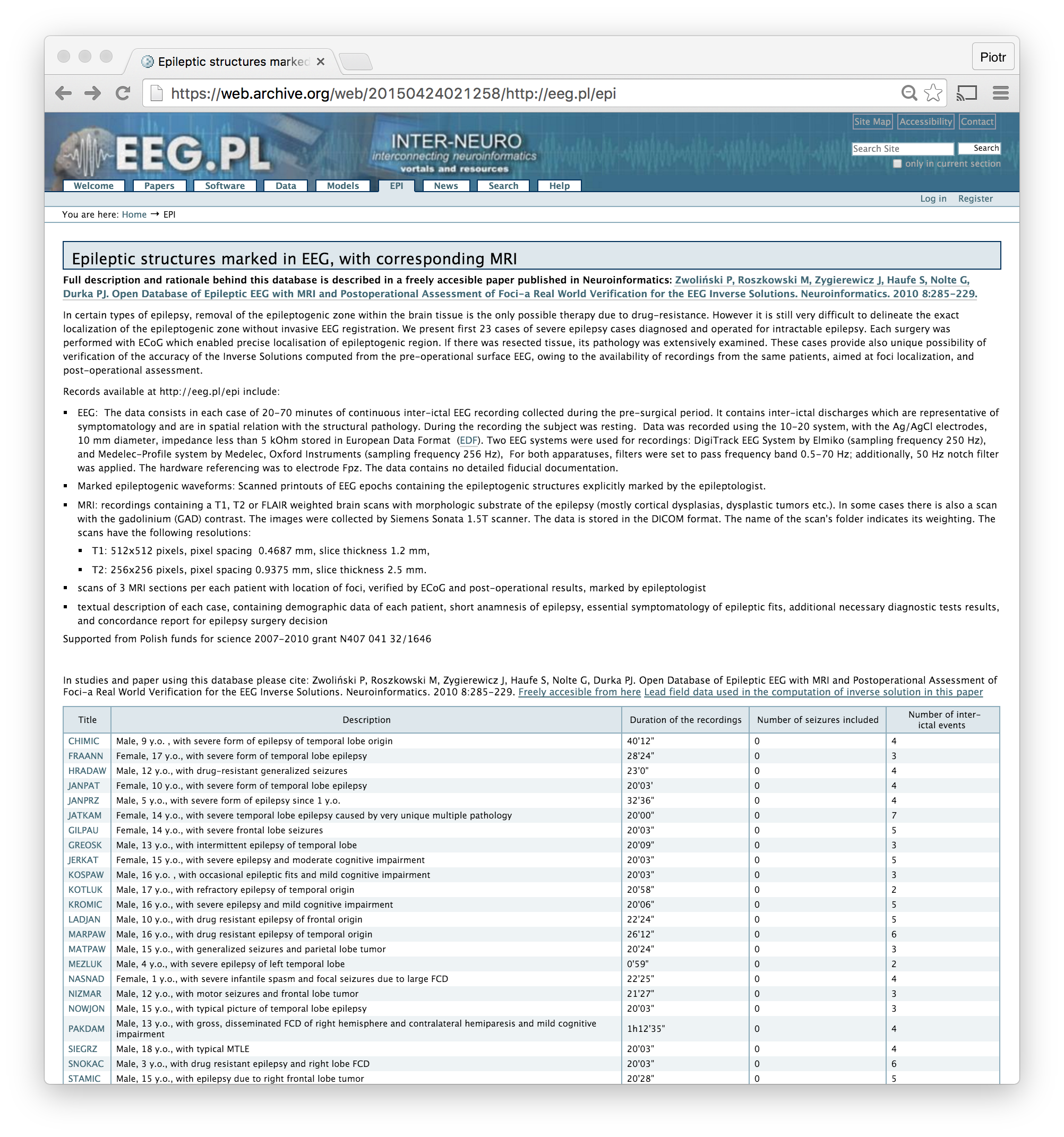
Epileptic structures marked in EEG
with corresponding MRI
In certain types of epilepsy, removal of the epileptogenic zone within the brain tissue is the only possible therapy due to drug-resistance. However it is still very difficult to delineate the exact localization of the epileptogenic zone without invasive EEG registration. We present first 23 cases of severe epilepsy cases diagnosed and operated for intractable epilepsy with intraoperative ECoG. These cases provide also unique possibility of verification of the accuracy of the Inverse Solutions computed from the pre-operational surface EEG, owing to the availability of intracranial recordings from the same patients, aimed at foci localization, and post-operational assessment.
Records available at http://eeg.pl/epi include:
- EEG recordings in 10-20 system, data in European Data Format (EDF), containing interictal discharges which are representative for symptomatology and are in spatial relation with the structural pathology, plus scanned printouts of few pages per each recording, containing those epileptogenic structures expliciltly marked by epileptologist
- MRI recordings containing brain scans with morphologic substrate of the epilepsy (mostly cortical dysplasias, dysplastic tumors etc.). These data are stored in the DICOM format. Each subject has a few folders containing the T1 or T2 types of scans. In some cases there are also scans with the gadolinium (GAD) contrast. The type of scan is encoded in the name of the folders.
- scans of 3 MRI sections per each patient with location of foci, verified by ECoG and post-operational results, marked by epileptologist
- textual description of each case, containing demographic data of each patient, short anamnesis of epilepsy, essential symptomatology of epileptic fits, additional necessary diagnostic tests results, and concordance report for epilepsy surgery decision
- Each surgery was performed with ECoG which enabled precise localisation of epileptogenic region.
- Each case of resected tissue was sent to pathology for extensive tissue sample examination
Supported from Polish funds for science 2007-2010 grant N407 041 32/1646
| Size | Description | Title |
|---|---|---|
| 1.3 MB | Male, born 1997, with severe form of epilepsy of temporal lobe origin |
|
| 1.3 MB | Female, born 1989, with severe form of temporal lobe epilepsy |
|
| 1.3 MB | Male, born 1994 with drug-resistant generalized seizures |
|
| 1.3 MB | Female, born 1996, with severe form of temporal lobe epilepsy |
|
| 1.1 MB | Male, born 2001, with severe form of epilepsy since 1 y.o. |
|
| 1.1 MB | Female, born 1993, with severe temporal lobe epilepsy caused by very unique multiple pathology |
|
| 984.5 kB | Female, born 1992, with severe frontal lobe seizures |
|
| 564.2 kB | Male, born 1992, with intermittent epilepsy of temporal lobe |
|
| 481.3 kB | Female, born 1993, with severe epilepsy and moderate cognitive impairment |
|
| 945.8 kB | Male, born 1990, with occasional epileptic fits and mild cognitive impairment |
|
| 524.6 kB | Male, born 1991, with refractory epilepsy of temporal origin |
|
| 1.1 MB | Male, born 1991, with severe epilepsy and mild cognitive impairment |
|
| 413.3 kB | Male, born 1998, with drug resistant epilepsy of frontal origin |
|
| 1.0 MB | Male, born 1990, with drug resistant epilepsy of temporal origin |
|
| 940.2 kB | Male, born 1992 with generalized seizures and parietal lobe tumor |
|
| 543.1 kB | Male, born 2002 with severe epilepsy of left temporal lobe |
|
| 548.8 kB | Female, born 2008, with severe infantile spasm and focal seizures due to large FCD |
|
| 1020.2 kB | Male, born 1994, with motor seizures and frontal lobe tumor |
|
| 1.0 MB | Male, born 1991, with typical picture of temporal lobe epilepsy |
|
| 436.7 kB | Male, born 1992, with gross, disseminated FCD of right hemisphere and contralateral hemiparesis and mild cognitive impairment |
|
| 1.0 MB | Male, born 1989, with typical MTLE |
|
| 954.4 kB | Male, born 2004, with drug resistant epilepsy and right lobe FCD |
|
| 493.1 kB | Male, born 1993, with epilepsy due to right frontal lobe tumor |
|